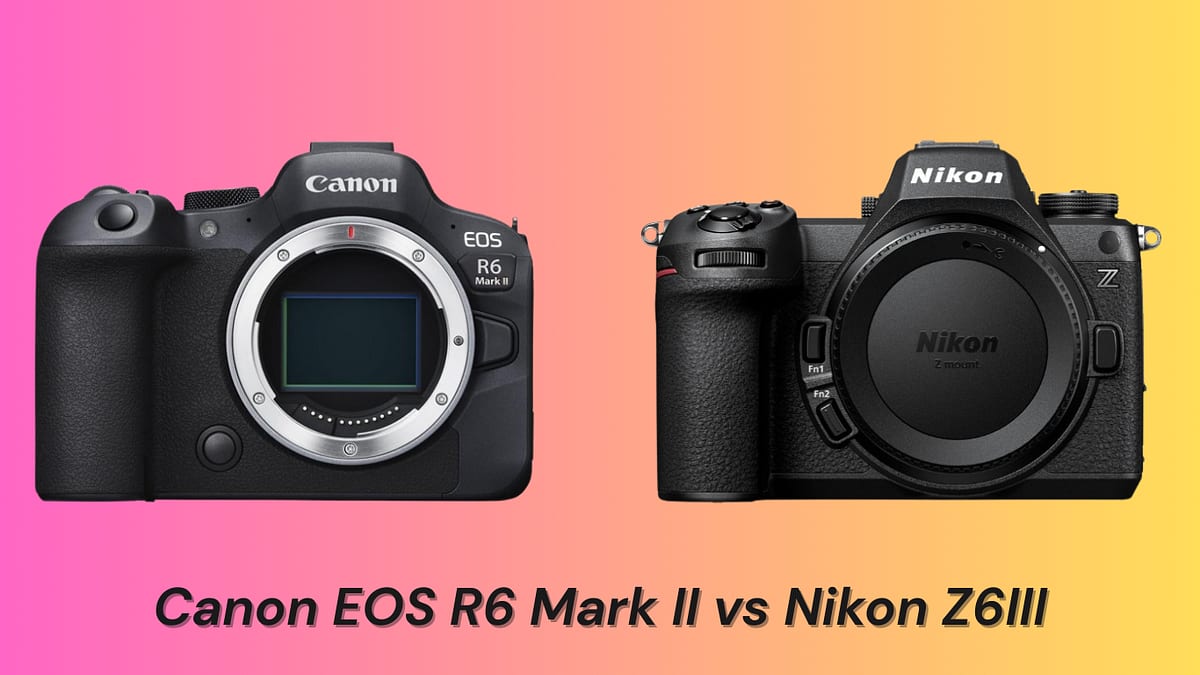
Canon EOS R6 Mark II vs Nikon Z6III
As an Amazon Associate we earn from qualifying purchases. Some links in this guide are affiliate links — see our affiliate disclosure for details.
There’s a unique kind of anxiety that comes with upgrading your camera. It’s not just about spending money; it’s about choosing a partner for the next few years of your creative journey. For the past five years, my trusty Canon 6D Mark II had been that partner. It captured birthdays, landscapes, and countless portraits, but its aging autofocus and limited video capabilities were starting to feel like a creative cage.
The time had come. The mirrorless world was calling, and my shortlist was brutally simple: the Canon EOS R6 Mark II and the brand-new Nikon Z6 III. This wasn’t just a spec-sheet comparison for me; it was a soul-searching mission.
Affiliate Disclosure: This article contains affiliate links to camera gear and lenses. If you click through and make a purchase, I may earn a commission. This helps me continue creating free photography content for readers like you — thank you for your support!
The Contender I Knew: Canon EOS R6 Mark II
I walked into the camera store with a bias. I was a Canon kid. My bag was full of EF lenses. The R6 Mark II felt familiar, like slipping on a well-worn glove. The menu system was a slightly evolved version of what I’d used for years. But the performance was anything but familiar.
I rented one for a weekend family reunion. The autofocus was… witchcraft. It locked onto my nephew’s eyes as he sprinted across the yard and didn’t let go. The 40 frames-per-second burst (electronic shutter) meant I caught the exact moment a cupcake was smooshed into a face, with perfect clarity. The 24.2MP sensor produced files that were wonderfully flexible in editing, with classic Canon colors that made skin tones look fantastic with minimal effort.
Where it Shone:
- Autofocus: Canon’s Dual Pixel AF II is legendary for a reason. It’s incredibly confident and easy to use.
- Stills Speed: A blazing-fast camera for action and fleeting moments.
- User Experience: It just makes sense. The flip-out touchscreen is brilliant.
My Hesitation: While the 6K oversampled 4K video was sharp, the crop on 4K/60p felt like a slight compromise. And as much as I loved the familiarity, a part of me wondered if I was just choosing comfort over innovation.
The Intriguing Newcomer: Nikon Z6 III
The Z6 III had just been announced, and everyone was buzzing about its “Partial Stacked” sensor. I’ll be honest, the spec sheet made my heart beat a little faster. I managed to get my hands on a demo unit for a low-light concert shoot.
The first thing I noticed was the viewfinder. Oh, the viewfinder! The 5.76-million-dot OLED is not just a number; it’s a revelation. It’s like looking through a window, not at a screen. Then there’s the new autofocus with subject detection VR. Tracking the singer through dramatic, strobe-lit moments felt more reliable than I expected, even in challenging light.
But the real game-changer was that video spec list: 6K/60p N-RAW internal recording. As someone dabbling more in hybrid work, this was a siren song. The high-speed 4K/120p had no crop, and the flat N-Log profile gave me a massive amount of dynamic range to play with. It felt like a camera built for the future.
Where it Shone:
- The Viewfinder & Display: Unmatched. It makes you want to compose through the viewfinder.
- Video Prowess: It’s not even a contest for serious video work. The Z6 III is a powerhouse.
- The “Feel”: The build quality is exceptional, and the new Real-Live Viewfinder mode is a clever trick for nailing manual exposure.
My Hesitation: The 24.5MP stills were great, but I had a slight preference for the Canon’s color science straight out of camera. More importantly, switching systems meant selling my beloved EF lenses and investing heavily in the Z-mount. That’s a huge financial and emotional hurdle.
The Side-by-Side Showdown in My Life
Putting these two cameras through their paces, here’s how they stacked up in the areas that mattered most to me.
When it came to stills autofocus, the Canon R6 Mark II felt flawless and incredibly intuitive, giving me an edge when photographing fast, erratic movement like kids or pets. The Nikon Z6 III, however, was excellent in its own right, feeling smarter with better performance in low light. For my needs, this category was essentially a tie; both systems are brilliant and far exceed what I was used to.
The difference was much clearer in video capability. The Canon is very good for hybrid shooters, but the crop on 4K/60p felt like a downside. The Nikon, however, is in a different league, offering professional-grade features like 6K N-RAW internal recording. For anyone serious about video, this is a clear win for the Z6 III.
In terms of handling and user interface, the Canon felt familiar, comfortable, and user-friendly right out of the box — a seamless transition. The Nikon had a more modern feel with a best-in-class viewfinder that was a genuine game-changer, though it came with a slight learning curve. This one boils down to personal preference, but I personally fell in love with the Nikon’s electronic viewfinder.
Both cameras have fantastic native lenses, so the lens ecosystem was a tie for me. Canon’s RF lenses are brilliant, and Nikon’s Z-mount lenses are arguably some of the sharpest on the market. You can’t go wrong with either.
Finally, there was the intangible “X” Factor. The Canon R6 Mark II was the safe, reliable, and brilliant all-rounder. The Nikon Z6 III, however, was the exciting and forward-looking choice, a true hybrid beast that felt more inspiring to use. For me, that inspiration tipped the scales.
The Decision I Made (And Why)
This was the hardest part. The Canon R6 Mark II was the logical choice. It was cheaper (especially considering my existing lens adapter), it was easier, and it was an incredible camera. I wouldn’t have been unhappy for a second.
But photography, for me, isn’t just about logic. It’s about passion. It’s about being excited to pick up the camera.
The Nikon Z6 III excited me. That viewfinder made me see compositions differently. The video specs opened up creative possibilities I didn’t have before. It felt like an investment in pushing my skills rather than just upgrading my gear.
So, I took the plunge. I sold my Canon gear, swallowed the cost, and bought the Nikon Z6 III. It was scary, but you know what? Two months in, I have zero regrets. The learning curve was short, and the results have been stunning. That EVF still puts a smile on my face every time I use it.
So, Which Camera is Right for YOU?
- Choose the Canon EOS R6 Mark II if: You are a Canon shooter looking for a seamless upgrade, your primary focus is stills photography (especially action/sports), and you want a fantastically capable and easy-to-use all-rounder. It’s a workhorse that won’t let you down.
- Choose the Nikon Z6 III if: You are a hybrid shooter who demands top-tier video features without compromise, you value the best viewfinder experience on the market, and you’re excited by cutting-edge technology. It’s the camera for those who want to grow into its capabilities.
In the end, my story isn’t about one camera being objectively “better” than the other. It’s about the R6 II being a brilliant conclusion to my old photographic chapter, and the Z6 III being the thrilling beginning of a new one. Go to a store, hold them both, and ask yourself not just what the camera can do, but how it makes you feel. Your answer might surprise you.

Photo by Elisa Photography on Unsplash

Photo by Demian Tejeda-Benitez on Unsplash

Photo by Esteban Yar on Unsplash

Written by
Marien CartelProfessional and Certified Digital Photographer born in the USA, with 22 years of experience in the field of photography.