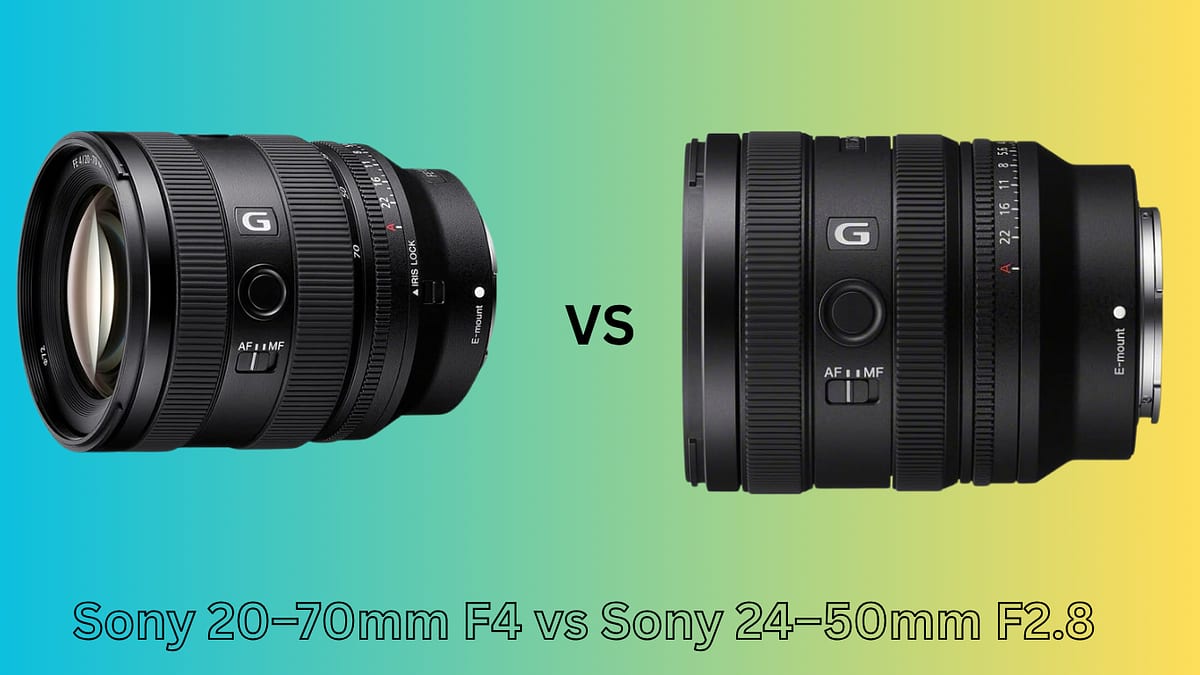
Sony 20–70mm F4 vs 24–50mm F2.8
As an Amazon Associate we earn from qualifying purchases. Some links in this guide are affiliate links — see our affiliate disclosure for details.
There’s a question that haunts every Sony mirrorless shooter looking for the perfect everyday zoom: Do I prioritize speed or range?
For years, my go-to travel and walk-around lens was the venerable 24–70mm f2.8. It was a beast — in both performance and weight. After one too many trips where my neck begged for mercy, I decided to downsize. But which modern, compact zoom was right for me?
This led me to a head-to-head battle between two of Sony’s most intriguing options: the Sony 20–70mm f4 G and the Sony 24–50mm f2.8 G.
Affiliate note: This post has affiliate links. If you buy through them, I might earn a small commission (at no extra cost). That helps me keep sharing my honest photography experiences, much love if you support!
Spoiler: I bought both. And here’s what I learned.
The Contenders: A Tale of Two Philosophies
On one side, you have the Sony 24–50mm f2.8 G. It’s the speed demon. A constant f2.8 aperture in a package so small and light it feels like a prime lens. It promises beautiful background blur (bokeh) and excellent low-light performance.
On the other, the Sony 20–70mm f4 G. It’s the range master. It starts at an ultra-wide 20mm, wider than almost any standard zoom, and still pulls back to a very useful 70mm. It sacrifices a stop of light (f4 vs f2.8) to give you an incredible field of view.

Check Today Deals on Sony 20–70mm f4 G
From Doubt to Revelation
I bought the 24–50mm f2.8 first. I was seduced by the f2.8 badge. I’m a photographer who loves available light and hates using a flash. The idea of a tiny, lightweight f2.8 zoom was a dream.
And for a while, it was. I took it on a weekend city trip. The size was liberating. It lived on my A7C II, fitting into a tiny sling bag. The images were razor-sharp, and the f2.8 aperture was magic in dimly lit cafes and for evening street photography. I could isolate subjects beautifully. For portraits at 50mm, f2.8 gave me that pop I craved.
But then, I found myself constantly switching to my iPhone.
We entered a stunning, narrow cathedral, and I physically couldn’t step back far enough to get the shot I wanted. 24mm wasn’t wide enough. On another day, I saw a unique architectural detail across the street. I zoomed in… and hit the 50mm limit. It wasn’t enough. I was missing shots, or worse, settling for them.
That’s when I swallowed my pride and rented the 20–70mm f4.
The difference was immediate. That 20mm wide-end is no gimmick; it’s a game-changer. I could capture entire building facades, vast landscapes, and tight interior shots without a second thought. And 70mm was long enough for most candid people shots and details. The range felt complete, holistic.
But what about the light? I was nervous about the f4 aperture. I took it out at the “golden hour” that bled into blue hour. And you know what? Modern cameras are incredible. My A7C II’s ISO performance handled 3200 and 6400 ISO with ease. The shot I got at 20mm, f4, and ISO 5000 was clean, vibrant, and useable — a shot I would have completely missed with the 24–50mm.
The Breakdown: How They Compare in My Hands
The Sony 24–50mm f2.8 G wins decisively in terms of aperture. Its constant f2.8 opening is superior for low-light photography and creating soft, blurred backgrounds (bokeh).
However, the Sony 20–70mm f4 G wins just as decisively in zoom range. Its ability to stretch from an ultra-wide 20mm to a standard-telephoto 70mm makes it far more versatile for travel and landscapes.
When it comes to size and weight, the 24–50mm f2.8 is the undisputed champion of portability, being significantly smaller and lighter. For close-focusing capabilities, the 20–70mm f4 has the advantage with its excellent, almost macro-like performance.
Ultimately, the 24–50mm f2.8 is ideal for street and low-light discreet shooting, while the 20–70mm f4 is the better tool for travel, landscapes, architecture, and vlogging.
So, Which One Did I Keep?
This is the million-dollar question, and the answer isn’t simple.
I kept the Sony 20–70mm f4 G.
Why? Because for my life — which involves travel, hiking, family gatherings, and casual photography — versatility is king. The ability to go from 20mm to 70mm without changing lenses means I capture more moments. The loss of the f2.8 aperture hurt, but I’ve mitigated it with great high-ISO performance and a fast prime in my bag for dedicated low-light or portrait nights (my tiny 35mm f1.8 is a perfect companion).
The 24–50mm f2.8 is a phenomenal lens, and I miss its speed and tiny form factor. It’s the perfect lens for someone who is a dedicated street photographer or who primarily shoots in low light and doesn’t need the wide or tele end. It’s a specialist.
But the 20–70mm f4? It’s the ultimate generalist. It’s the one lens I can take anywhere and be confident I’m ready for 95% of what I’ll see.

Check Today Deals on Sony 20–70mm f4 G
The Final Frame
Your choice, like mine, will come down to your personal story. Ask yourself:
- Do you live in cafes and city streets at night? The 24–50mm f2.8 might be your soulmate.
- Do you crave wide vistas, travel without a bag full of lenses, and hate missing a shot? The 20–70mm f4 is likely your perfect partner.
For me, the 20–70mm’s incredible range told a more complete story of my adventures. And in the end, that’s what photography is all about.
What’s your priority: speed or story? Let me know in the comments which one you’d choose!

Photo by Dex Ezekiel on Unsplash

Photo by Leo_Visions on Unsplash

Photo by Nicolas J Leclercq on Unsplash

Written by
Marien CartelProfessional and Certified Digital Photographer born in the USA, with 22 years of experience in the field of photography.