Best Leica Camera for Travel: Top Picks & Sensor Comparison
As an Amazon Associate we earn from qualifying purchases. Some links in this guide are affiliate links, see our affiliate disclosure for details.
Which Leica camera is best for travel?
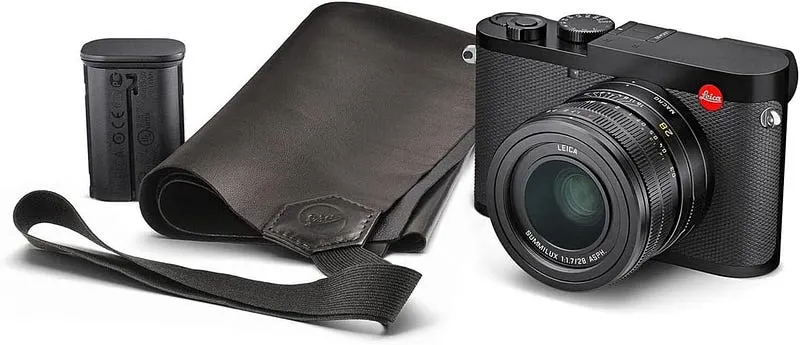
The Leica Q2 is this breakdown's contender for the best Leica travel camera: a full-frame compact with a 47-megapixel sensor and a fixed 28mm f/1.7 Summilux lens, in a weather-sealed body that weighs about 730 g. It suits travellers who value image quality, build and a simple one-lens workflow, and who can afford it. Its successor, the Leica Q3, adds a 60-megapixel sensor and a tilting screen, and cheaper compacts such as the Sony RX100 series or Fujifilm X100V cost a fraction of the price.
What makes a good travel camera?
- Portability. It should fit a small bag and be comfortable all day.
- Image quality. Travel scenes range from dim markets to bright landscapes.
- Weather resistance. Rain and dust are part of travel.
- Simplicity. Fewer settings and fewer lenses mean more attention on the scene.
- Reliability. A camera that is built to last matters far from home.
Leica Q2

Photo by zakariae daoui on Unsplash
The Leica Q2 is a full-frame compact with a fixed 28mm f/1.7 Summilux lens. Its key points, from Leica's published specifications:
- Image quality. A 47.3-megapixel full-frame sensor and a sharp, bright lens give very high image quality in a small body.
- Wide aperture. f/1.7 helps in low light and gives some background separation.
- Crop modes. Digital crop modes simulate 35mm, 50mm and 75mm framelines, which add flexibility without switching lenses, though the image is cropped.
- Build. The body is dust- and splash-resistant (IP52), and it is built to last.
- Stabilization. The lens is optically stabilized.
- Video. It records 4K video, but it is primarily a photographer's tool.
Is the Leica Q2 the best travel camera for you?
This is not a casual purchase, so consider the fit.
The Q2 suits you if:
- You value experience and immersion over having every focal length.
- You want excellent image quality without the bulk of an interchangeable-lens system.
- You appreciate a refined design that feels like an extension of your hand.
- You want a camera built to last for years.
You might look elsewhere if:
- You need optical zoom for wildlife or sports. The digital crop modes are not the same.
- Your budget is tight. Alternatives such as the Sony RX100 series or Fujifilm X100V cost far less.
- You are mainly a videographer.
Photo by Matteo del Piano on Unsplash
Alternatives
| Camera | Strength | Trade-off |
|---|---|---|
| Leica Q3 | 60 MP, tilting screen | Higher price |
| Sony RX1R III | Smaller and lighter | Fixed 35mm lens, no stabilization |
| Fujifilm X100V or X100VI | Compact and affordable | APS-C sensor |
| Ricoh GR III | Pocket-sized | Fixed 28mm lens |
| Sony RX100 series | Pocketable zoom | Small sensor |
See the best Leica cameras, the comparison of the Sony RX1R III and Leica Q3, the comparison of the Ricoh GR III and Fujifilm X100VI and the best 4K travel camera.
The verdict
The Leica Q2 asks for engagement with the scene and rewards it with excellent images in a durable body. For travellers who want that experience and can afford it, it is a standout. Others will do just as well with a cheaper compact.
Frequently asked questions
Is the Leica Q2 weather sealed? Leica lists dust and splash resistance, but it is not waterproof.
Does the Q2 have a zoom? No. It has a fixed 28mm lens with digital crop modes.
Is the Q2 good for video? It records 4K video, but it is mainly a stills camera.
Is the Q3 better than the Q2? It has a higher-resolution sensor and a tilting screen, at a higher price.
Camera & Lens Settings by Real-World Use Case
Match your focal length, aperture, shutter speed, and lighting modifier to the exact environment you shoot in.
Street Photography, Japan/Europe Trips & Backpacking
- Best Body:
- Fujifilm X100VI / Ricoh GR III / Fujifilm X-T30 II / Sony a6700
- Ideal Lens:
- 23mm f/2 or 27mm f/2.8 Pancake (APS-C) — 35mm to 40mm equivalent
- Aperture & Shutter:
- f/2.0 (neon night street) or f/5.6 – f/8 (sunny zone-focusing from 2m to infinity) · 1/250s – 1/500s (freezes pedestrians mid-stride)
- Room Distance:
- 1.5m – 5m (candid street distance)
DJ Sets, Boiler-Room Booths & Nightlife Video
- Best Body:
- Sony a7 III / Sony ZV-1 / GoPro HERO 13 (crowd B-cam)
- Ideal Lens:
- 24mm f/1.8 or 16–35mm f/2.8 (tight DJ booth) + 35mm f/1.4 (crowd)
- Aperture & Shutter:
- f/1.4 – f/2.8 · 1/50s – 1/60s (video) or 1/200s (stills)
- Room Distance:
- 0.8m – 1.5m clamped to booth truss or heavy weighted stand (isolated from subwoofers)
Tattoo Artists & Micro-Realism Portfolios
- Best Body:
- Sony Alpha a7 III / Fujifilm X-T4
- Ideal Lens:
- 90mm f/2.8 Macro (detail) or 50mm f/1.8 (sleeves & back pieces)
- Aperture & Shutter:
- f/5.6 – f/8 (keeps curved forearms and calves sharp edge-to-edge) · 1/125s – 1/200s handheld (or 1/60s on tripod)
- Room Distance:
- 0.4m – 1.5m (1.5 to 5 ft)

Written by
Marien CartelMarien Cartel runs Marien Cartel Photography, a camera and lens buying-guide site, and photographs the gear shown on it.
Related Guides

Best Affordable Camera for Travel: Top Picks & Sensor Comparison
Best Affordable Camera for Travel: a side-by-side look at Canon EOS R50, Sony ZV-E10 and Canon EOS R100, with strengths, trade-offs and buying advice.
Best Camera for Japan Trip: Top Picks & Sensor Comparison
Best Camera for Japan Trip — what the Sony Alpha 7C offers, where it falls short, and whether it is worth buying.
Best Camera for Stock Photography: Top Picks & Sensor Comparison
Best Camera for Stock Photography — Sony a6400, Sony a7 IV and Canon EOS R6 Mark II compared, with pros, cons and who should buy which.

Best Mirrorless Cameras Under $2000: Top Picks & Sensor Comparison
The world of photography is constantly evolving, and mirrorless cameras have taken center stage, offering incredible image quality, compact designs, and
Best Full-Frame Camera for Beginners: Top Picks & Sensor Comparison
Best Full-Frame Camera for Beginners: Canon EOS R8, Nikon Z5 and Sony A7C II compared on features, price and who each one suits.
Best Canon Cameras: Top Picks & Sensor Comparison
Best Canon Cameras — Canon EOS 90D, Canon EOS R6 and Canon EOS R5 compared, with pros, cons and who should buy which.