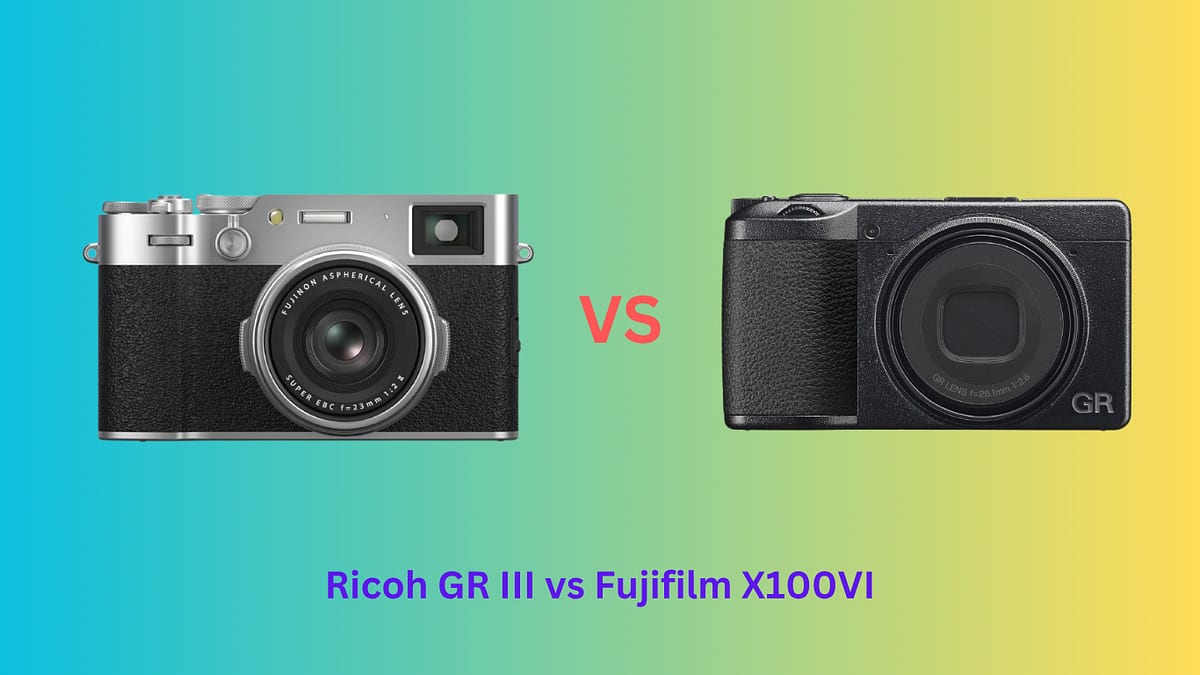
Ricoh GR III vs Fujifilm X100VI
As an Amazon Associate we earn from qualifying purchases. Some links in this guide are affiliate links — see our affiliate disclosure for details.
I spent four months going back and forth on this decision. Not because I couldn’t afford either camera — because I genuinely couldn’t decide which version of “carrying less gear” I actually wanted. That sounds like a strange problem to have, but if you’ve ever stood in a camera shop holding both of these, you know exactly what I mean.
- Ricoh GR III — View on Amazon
- Fujifilm X100VI — View on Amazon
Affiliate note: This post has affiliate links. If you buy through them, I might earn a small commission (at no extra cost).
Why I Was Even Looking
I’d been shooting street and travel work with a bag full of gear for years — a mirrorless body, three lenses, a flash I used maybe twice a year. The turning point was a trip to Lisbon where I left the big kit at the hotel out of sheer exhaustion and just walked with my phone for two days. The photos were fine. But I missed having control — real aperture, real files, real intention behind the shot. I wanted something between “phone” and “everything I own strapped to my body.”
That’s when I started reading about pocketable, fixed-lens cameras, which is also when I went down the rabbit hole I later turned into my guide to the best compact cameras for street photography — funnily enough, the GR III was the camera that kept pulling me back in even then, months before I owned one.
The Ricoh GR III: My First Purchase

I bought the Ricoh GR III first, mostly because of its reputation as the ultimate “always in your pocket” camera. And for the first month, it delivered exactly that. It genuinely disappears into a jacket pocket. I started carrying it everywhere — the grocery store, dog walks, boring commutes — because there was zero friction to having it with me.
The 28mm fixed lens forced me to get closer to things, which sounds like a small change but completely shifted how I shot. Snap Focus became second nature within a week: pre-set your distance, half-press disappears entirely, you just shoot the moment as it happens. For candid street work, nothing I’ve used since gets out of your way faster.
But here’s what I didn’t expect: the battery life frustrated me constantly. I was swapping batteries mid-day more often than I wanted to admit, and there’s no viewfinder, which meant bright afternoons in Lisbon-style sunlight had me squinting at a screen I could barely see. It’s a camera built entirely around one philosophy — get out of the way — and it does that beautifully, right up until you need it to do anything else.
Ricoh GR III — View on Amazon
Why I Almost Returned It for the X100VI

Three months in, a friend let me handle her Fujifilm X100VI for an afternoon, and I felt something I wasn’t prepared for: mild betrayal toward my own camera. The hybrid viewfinder alone changed how confident I felt composing in harsh light. The dials — actual physical dials for shutter speed and aperture — made the whole experience feel less like operating a device and more like using a tool I understood with my hands, not just my eyes.
The image stabilization was the other thing that got me. Handheld low light shots that would’ve been a throwaway on the GR III came out usable, sometimes genuinely good, on the X100VI. And Fujifilm’s color science meant fewer edits before something felt “done” — which matters more than people admit when you’re shooting for yourself, not a client.
I seriously considered selling the GR III that week. I didn’t, and I’m glad I waited, because living with both for the past year taught me something neither spec sheet tells you.
Fujifilm X100VI — View on Amazon
What I Actually Learned Living With Both
The GR III is a camera for capturing life as it happens around you — reactive, invisible, built for speed over deliberation. The X100VI is a camera for making a photograph — considered, tactile, built for people who want the process to feel like something, not just produce a result.
I reach for the GR III when I’m not really “going out to shoot” — it’s the camera that comes with me by default because it costs nothing to carry. I reach for the X100VI when I know I’m making images, when the light matters and I want to slow down and actually compose rather than react.
Neither is more “correct.” But if I’m honest about which camera changed how I shoot rather than just where I shoot from, it’s the X100VI. The viewfinder and dials pulled me back into being deliberate in a way I’d drifted away from with years of autofocus-and-forget mirrorless shooting.
My Actual Recommendation
If your priority is a camera that vanishes into your pocket and never becomes a reason you didn’t bring a camera at all — get the Ricoh GR III. It is, without exaggeration, the camera you will actually have with you.
If you want a camera that makes the act of shooting feel deliberate again, with a viewfinder, better low-light handling, and controls that reward learning them — get the Fujifilm X100VI. It costs more, it’s heavier, and it will absolutely still fit in a jacket pocket, just not one you forget is there.
I kept both. That’s not a cop-out answer — it’s the honest result of a year spent trying to prove one of them unnecessary and failing both times.
Which camera is better for street photography specifically?
The GR III has the edge for pure street work — smaller, faster to deploy, and Snap Focus is unmatched for candid speed. The X100VI is better if your street work leans more considered or environmental, where composing through a viewfinder matters.
Is the price difference between them justified?
The X100VI costs meaningfully more, and you’re paying for the viewfinder, in-body stabilization, and build quality. Whether that’s “worth it” depends entirely on whether you’ll use those features — if you mostly shoot in good light and value pure portability, the GR III gives you most of the image quality for less money and less bulk.
Can either of these replace a full mirrorless kit?
For a huge percentage of everyday and travel photography, yes. Where they can’t compete is genuine long-telephoto or specialty work — sports, wildlife, studio setups. For documentary, street, and travel shooting, either one can realistically become your primary camera.

Photo by Salah Regouane on Unsplash

Photo by Maksym Tymchyk 🇺🇦 on Unsplash
Written by
Marien CartelProfessional and Certified Digital Photographer born in the USA, with 22 years of experience in the field of photography.
Related Guides
Nikon Z8 Review
A Professional Photographer’s Comprehensive Review
Nikon Zf vs Fujifilm X100VI
The Tactile Dilemma: Why the Fujifilm X100VI and Nikon Zf Forced Me to Rethink Everything
Best Focal Length for Portraits
Finding My Focus: My Photography Journey to the Best Focal Length for Portraits