Tokina ATX-M 11–18mm F2.8 X-Mount Review
As an Amazon Associate we earn from qualifying purchases. Some links in this guide are affiliate links, see our affiliate disclosure for details.
Is the Tokina ATX-M 11-18mm f/2.8 worth buying?
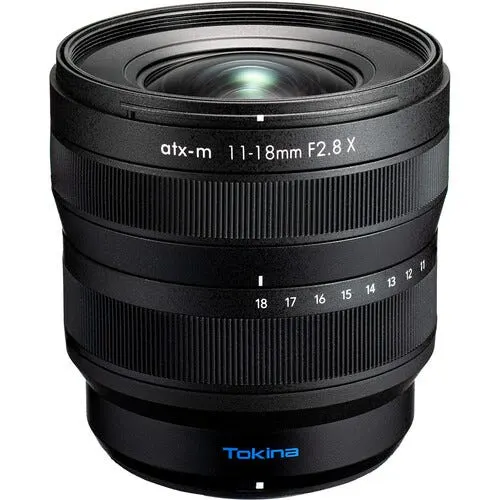
The Tokina ATX-M 11-18mm f/2.8 is worth buying for Fujifilm X-mount shooters who want a fast, light wide-angle zoom at a lower price than first-party glass. It has a constant f/2.8 aperture, a 67 mm filter thread, weighs about 320 g and focuses as close as 19 cm at 11mm. It suits landscapes, interiors and astrophotography. The trade-offs are a shorter zoom range than some rivals and no optical stabilization.
Key specifications
| Spec | Tokina ATX-M 11-18mm f/2.8 (X mount) |
|---|---|
| Focal length | 11-18mm (about 16.5-27mm in full-frame terms on APS-C) |
| Aperture | Constant f/2.8, minimum f/22, nine rounded blades |
| Weight | About 320 g (some sources list 318 g) |
| Filter thread | 67 mm |
| Minimum focus | 19 cm at 11mm, 30 cm at 18mm |
| Other | Micro-USB port for firmware updates, weather-sealing gasket at the mount |
Sources: Tokina USA's product page, Adorama's listing and Dustin Abbott's review.
Design and handling

Photo by Josh Hild on Unsplash
The lens has a modern, compact design with a constant aperture throughout the zoom range. A constant f/2.8 keeps exposure stable when zooming, which helps video, and lets in more light for night skies than an f/4 zoom. A weather-sealing gasket at the mount protects against moisture and dust, although the lens is not described as fully weather sealed. The 67 mm filter thread matches many other Fujifilm and third-party lenses, so filters can be shared.
Image quality and focusing

Photo by Anastasia Ulyanova on Unsplash
Reviewers describe the lens as sharp in the centre and well controlled for distortion and chromatic aberration. Corners soften at 18mm wide open, which is common for wide zooms, and stopping down improves them. Autofocus is quick for stills and video. The manual focus ring is a weaker point, with limited precision.
Who is it for?
- Landscape photographers. The 11mm end gives dramatic wide perspective.
- Interior and real-estate photographers. The range suits tight rooms.
- Astrophotographers. A bright f/2.8 aperture helps with stars.
- Video shooters. A constant aperture and quiet autofocus help.

How does it compare with alternatives?
| Lens | Aperture | Stabilization | Notes |
|---|---|---|---|
| Tokina ATX-M 11-18mm | f/2.8 | No | Fast and light; lower price than first-party options |
| Fujifilm XF 10-24mm f/4 R OIS WR | f/4 | Yes | Wider range, weather-resistant and stabilized |
The Fujifilm lens has optical stabilization and a wider range, while the Tokina offers a brighter aperture. See this breakdown to the best third-party lenses for Fujifilm X mount and the best lenses for the Fujifilm X-T5 for more choices.
Pros and cons
| Pros | Cons |
|---|---|
| Constant f/2.8 aperture | No optical stabilization |
| Light at about 320 g | Corners soften at 18mm wide open |
| Quick autofocus | Manual focus ring lacks precision |
| Weather-sealing gasket at the mount | Shorter zoom range than some rivals |
| Priced below first-party options | Modest close-focus performance |

Photo by Alexandra Uivarasan on Unsplash
Frequently asked questions
Does the lens work on the Fujifilm X-T5? Yes. It is made for the X mount and suits the 40-megapixel sensor, according to reviews.
Does it have image stabilization? No. Fujifilm bodies with in-body stabilization, such as the X-T5, help compensate.
Can it be used for astrophotography? Yes. The f/2.8 aperture and wide angle suit night skies, though corners soften wide open.
Does it fit filters? Yes. It takes 67 mm screw-in filters.
Camera & Lens Settings by Real-World Use Case
Match your focal length, aperture, shutter speed, and lighting modifier to the exact environment you shoot in.
Tattoo Artists & Micro-Realism Portfolios
- Best Body:
- Sony Alpha a7 III / Fujifilm X-T4
- Ideal Lens:
- 90mm f/2.8 Macro (detail) or 50mm f/1.8 (sleeves & back pieces)
- Aperture & Shutter:
- f/5.6 – f/8 (keeps curved forearms and calves sharp edge-to-edge) · 1/125s – 1/200s handheld (or 1/60s on tripod)
- Room Distance:
- 0.4m – 1.5m (1.5 to 5 ft)
Barbershops, Hairstylists & Color Salons
- Best Body:
- Sony a7 IV / Canon EOS R6 Mark II
- Ideal Lens:
- 50mm f/1.8 (tight stations) or 85mm f/1.8 (spacious salons)
- Aperture & Shutter:
- f/1.8 – f/2.8 (blurs background chairs while keeping the lineup tack-sharp) · 1/160s – 1/250s (freezes subtle head movement in the chair)
- Room Distance:
- 1.5m – 2.4m (5 to 8 ft from the styling chair)
Makeup Artists (MUA) & Beauty Tutorials
- Best Body:
- Sony Alpha a6400 / Canon G7 X Mark III
- Ideal Lens:
- Sigma 56mm f/1.4 DC DN (APS-C) or 50mm–85mm f/1.8 (Full Frame)
- Aperture & Shutter:
- f/2.8 – f/4 for full-face sharpness; f/5.6 for macro eye/lip close-ups · 1/125s for stills; 1/50s (24p) or 1/120s (60p) for video tutorials
- Room Distance:
- 1.2m – 2.2m (4 to 7 ft)

Written by
Marien CartelMarien Cartel runs Marien Cartel Photography, a camera and lens buying-guide site, and photographs the gear shown on it.
Related Guides
Sony 20–70mm F4 vs 24–50mm F2.8: Top Optics by Budget & Use Case
Sony 20–70mm F4 vs 24–50mm F2.8: key differences in sharpness, autofocus, build and price, and which one suits you.
Meike 33mm f/1.4 AF Review: Optical Reach, Autofocus & Picks
In testing and spec comparisons, the Meike 33mm f/1.4 AF holds up well against lenses that cost about twice as much.
Best Fujifilm X-Mount Lenses: (Guide & Reviews)
Best Fujifilm X-Mount Lenses: Fujifilm XF 35mm f/1.4 R and Fujifilm XF 56mm f/1.2 R compared on features, price and who each one suits.
Best Third-Party Lenses for Fujifilm X-Mount
Best Third-Party Lenses for Fujifilm X-Mount — Viltrox Primes 23mm f/1.4 and Samyang 12mm f/2 compared, with pros, cons and who should buy which.
Sony a6700 vs Sony a7R IV for Outdoor & Adventure Photography
Compare the Sony a6700 vs Sony a7R IV for outdoor and adventure photography: APS-C portability and AI autofocus vs 61MP full-frame landscape resolution.
Nikon Z5 II Review: Field Setup & Key Specs
Nikon Z5 II Review: a side-by-side look at Canon R8 and Sony a7C II, with strengths, trade-offs and buying advice.