3 Best Time Lapse Camera for Plants: Field Setup & Key Specs
As an Amazon Associate we earn from qualifying purchases. Some links in this guide are affiliate links, see our affiliate disclosure for details.
Top Picks & Key Specifications at a Glance
| Model | Best For | Mount / System | Key Optical & Sensor Specs | Check Price |
|---|---|---|---|---|
1Best overall dedicated camera: Brinno TLC2020 | Top Overall Pick | Interchangeable-Lens System | High-Resolution Optics & Fast AF | Amazon ↗ |
2GoPro Hero 12 | Best for quality | Fixed-Lens Compact / Action | High-Resolution Optics & Fast AF | Amazon ↗ |
3Canon EOS Rebel T7 | DSLR option | Canon EF / EF-S DSLR | High-Resolution Optics & Fast AF | Amazon ↗ |
Best Options for plant time-lapse
For long, set-and-forget plant time-lapses, the Brinno TLC2020 is the simplest dedicated option. It records Full HD with HDR, runs on four AA batteries and is rated at up to 82 days at a five-minute interval. The GoPro Hero 12 gives higher image quality but needs external power for long projects, and the PlantCam is an app-based option for indoor hobbyists. A DSLR such as the Canon EOS Rebel T7 can also work with an external intervalometer.
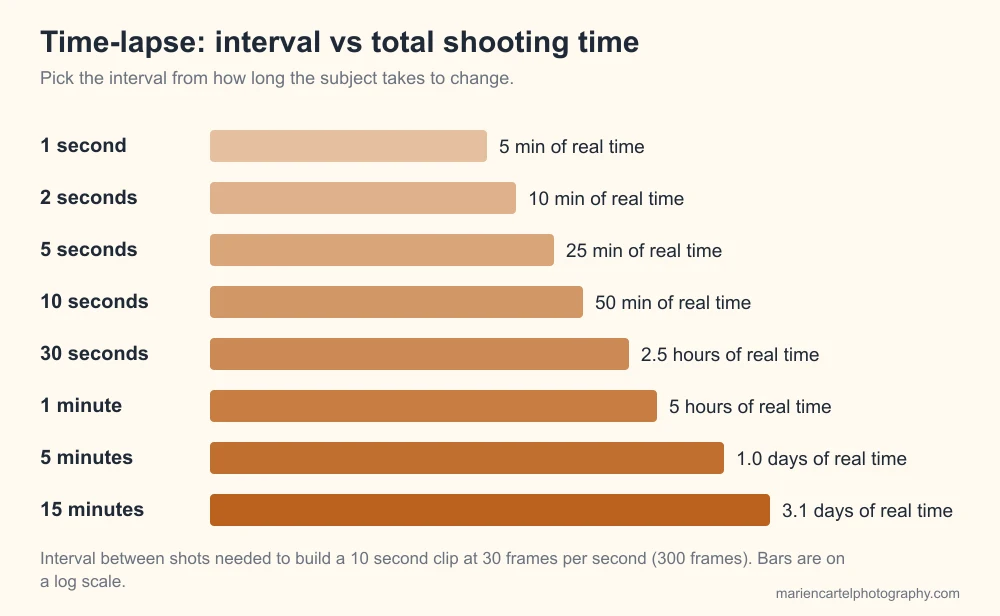
Interval between shots against real shooting time for a 10-second, 30 fps clip. Original diagram for this site.
What matters for plant time-lapse?
- Battery life or external power. Plants grow for days or weeks, so the camera must keep running.
- Interval control. The interval sets how fast growth looks on screen.
- Stable position. The camera must not move between frames.
- Consistent exposure. Light changes cause flicker in the final video.
- Storage. Thousands of frames need a large memory card.
Best overall dedicated camera: Brinno TLC2020
The Brinno TLC2020 is a purpose-built time-lapse camera. Retailers list a 2 MP sensor recording Full HD with HDR, a 2-inch screen, microSD cards up to 128 GB and a body weight of about 97.5 g without batteries. Battery life is quoted at no less than 82 days at a five-minute interval in time-lapse mode, according to Photo Specialist's listing. It suits long projects, such as a seed growing for months, where reliability matters more than resolution.
Best for quality: GoPro Hero 12
The GoPro Hero 12 records high-resolution video and has a time-lapse mode. Its small battery does not last for weeks, so long plant projects need external USB power. It suits shorter projects, such as a flower opening over a day, where image quality matters.
Best for beginners: PlantCam
The PlantCam is built for indoor plant hobbyists and uses an app-based workflow, which makes setup simple. It suits people who want to start quickly without learning camera settings.
DSLR option: Canon EOS Rebel T7
The Canon EOS Rebel T7 takes sharp photos, and its image quality and low-light performance suit plant work. It has no built-in interval timer, so it needs an external intervalometer to fire the shutter automatically, which adds cost. See time-lapse interval and shoot length for how to set the interval.
DIY option: Raspberry Pi camera
A Raspberry Pi with a camera module can capture photos on a schedule, with full control over the interval and storage. It needs some technical skill to set up.
How do the options compare?
| Camera | Best for | Main limit |
|---|---|---|
| Brinno TLC2020 | Long, set-and-forget projects | Modest 2 MP resolution |
| GoPro Hero 12 | Higher image quality | Needs external power for long projects |
| PlantCam | Beginners | Less control |
| Canon EOS Rebel T7 | Best photo quality | Needs an intervalometer |
| Raspberry Pi | Custom setups | Technical setup |
Tips for stunning plant time-lapses
- Fix the position. Use a sturdy tripod or a clamp so the camera cannot shift.
- Control the light. A grow light on a timer keeps exposure consistent. Avoid windows that change through the day.
- Choose the interval by growth speed. A seedling might use a 10 to 15 minute interval, while a fast bloom needs a shorter one. At 30 frames per second, 300 frames make a 10-second clip, so a 15-minute interval covers about three days.
- Lock exposure and focus. Manual settings reduce flicker.
- Add a marker. A ruler or a pot in frame gives scale.
- Check storage and power. Calculate frames per day and card size before starting.
For the editing side, see how to make a time-lapse video and why time-lapse looks jerky. More cameras are covered in the best video camera for time-lapse guide.
Frequently asked questions
How often should the camera take a photo? For slow-growing plants, every 10 to 30 minutes works. Faster events, such as a flower opening, need an interval of seconds to a few minutes.
How long should a plant time-lapse run? From a day for a bloom to months for a full life cycle. Plan power and storage for the whole period.
Do I need a special camera? No. Any camera that can take photos on a schedule works, but dedicated time-lapse cameras are simplest.
How can I stop flicker? Use constant lighting, manual exposure and, if needed, a de-flicker filter in editing software.
Camera & Lens Settings by Real-World Use Case
Match your focal length, aperture, shutter speed, and lighting modifier to the exact environment you shoot in.
YouTube Talking-Head, Podcasting & Desk Streaming
- Best Body:
- Sony ZV-E10 II / Sony a6700 / Canon EOS R50
- Ideal Lens:
- Sigma 16mm f/1.4 DC DN (APS-C) or 24mm f/1.8 (Full Frame)
- Aperture & Shutter:
- f/1.4 – f/2.0 (separates speaker from a close desk wall within 4 feet) · 1/50s (for 24fps) or 1/60s (for 30fps) — 180-degree shutter rule
- Room Distance:
- 0.8m – 1.4m (2.5 to 4.5 ft desk arm mount)
Overhead Top-Down Videos (Cooking, Crafts, Art & Unboxings)
- Best Body:
- Sony ZV-E10 II / Sony a6400 / Canon EOS R50
- Ideal Lens:
- Sigma 18–50mm f/2.8 DC DN or Sony E 15mm f/1.4 G / 24mm f/2.8
- Aperture & Shutter:
- f/4 – f/5.6 (deep enough that hands lifting objects off the table stay in focus) · 1/60s (30p) or 1/120s (60p for smooth hand movements)
- Room Distance:
- 0.7m – 1.1m directly above the tabletop
Gym Workouts, Fitness Coaching & Athletic Reels
- Best Body:
- Sony ZV-1 / Panasonic Lumix GH5 & GH7 / Sony a7 III
- Ideal Lens:
- 24mm–35mm f/1.8 or 16–35mm f/2.8 Zoom
- Aperture & Shutter:
- f/1.8 – f/2.8 (isolates athlete from crowded gym equipment) · 1/120s (for 4K 60fps slow-motion) or 1/60s (for 30fps)
- Room Distance:
- 1.5m – 3.0m (5 to 10 ft on a compact floor tripod or magnetic mount)

Written by
Marien CartelMarien Cartel runs Marien Cartel Photography, a camera and lens buying-guide site, and photographs the gear shown on it.
Related Guides
Best Camera for Filming Garden Wildlife: Field Setup & Key Specs
Best Camera for Filming Garden Wildlife — Sony α7 IV and Canon EOS R6 Mark II compared, with pros, cons and who should buy which.
Best Camera for Vlogs: Field Setup & Key Specs
Sony ZV-E10, Sony ZV-1 II and DJI Osmo Pocket 3 compared for Camera for Vlogs: key specifications, trade-offs, and top picks by budget.
Best Cameras for Virtual Production: Field Setup & Key Specs
Sony FX6 and Sony FX9 compared for Cameras for Virtual Production: key specifications, trade-offs, and top picks by budget.
Best Camera for Ice Hockey Photography: Field Setup & Key Specs
Canon EF 70–200mm f/2.8L and Sony FE 70–200mm f/2.8 GM compared for Camera for Ice Hockey Photography: key specifications, trade-offs, and top picks by budget.
Best Camera for Hobby Photography: Field Setup & Key Specs
Best Camera for Hobby Photography — what the Olympus OM-D E-M10 Mark IV offers, where it falls short, and whether it is worth buying.
Best Camera for Basketball Games: Field Setup & Key Specs
Best Camera for Basketball Games: Sony A6700, Fujifilm X-H2S and Sony A9 III compared on features, price and who each one suits.